
From the Inside
They Had One Job: Six Weeks in the SHU and the Night the System Failed Jeffrey Epstein
I read CNN's long piece on Jeffrey Epstein's final nine months in federal custody, and it pulled me straight back to my own six weeks in the Special Housing Unit. If you have a loved one heading into the system, or you are facing it yourself, I want to walk you through what I actually saw, because it changes how you read about Epstein's final night.
I want to be clear about who I am before I say another word. I am not a doctor. I am not a forensic expert. I served thirty-five months in the Federal Bureau of Prisons, including time in the SHU, and what I carry is lived experience, not a credential. So when I tell you something about how that unit runs, it is because I lived inside the routine, counted the footsteps in the hallway at night, and watched men get put on watch.
Here is the thing that has stuck with me since I closed that article. The place where Epstein died was supposed to be the one place in the building where dying alone was almost impossible.
What Is the SHU?
The Special Housing Unit or SHU goes by a lot of names on the inside. The hole. The box. Segregation. It is a locked unit inside the prison where a person is separated from everyone else, either for discipline, for an investigation, or for their own protection. You do not walk anywhere on your own. You are cuffed and individually escorted for every movement. Your property is stripped down to almost nothing. Meals come to the door. And you are counted and checked on a schedule that does not bend.
That last part is the part people on the outside never picture. In the SHU, officers are required to walk the tier and physically lay eyes on each cell on a set rotation, and overnight that rounds requirement runs roughly every thirty minutes. It is not a suggestion. It is the spine of how the unit is intended to work. Every pass, every visitor, every interaction is logged. The whole design of the place assumes that a person in segregation may be at their lowest, so the system removes the means and shortens the gaps between checks.
What I Experienced
My time was served in a minimum security federal prison camp. Low fences, no walls, the bottom rung of the security ladder. I will tell you something that surprises people: that camp was run strictly and mostly by the book. The daily counts were religious and timely. The paperwork was recorded. When a man was struggling, staff moved and took the situation seriously.
I witnessed men get placed on psychological holds. I watched the step up to suicide watch. When that happened, the man was stripped of his standard prison issued onesie and handed a tear-resistant safety smock, the stiff paper-feeling gown that cannot be twisted, knotted, or torn into anything. No regular clothing. No sheets to be ripped up and used as a noose. No shoelaces EVER. Nothing in that cell that a person could turn against himself. And suicide watch means exactly what it says: continuous, around-the-clock observation of the individual. Someone is watching, on camera and in person, the entire time. Psychological observation is the step below that, used when staff judge a person is not imminently at risk but still wants eyes kept on him or her.
What is an MCC? Why does it matter here with Epstein?
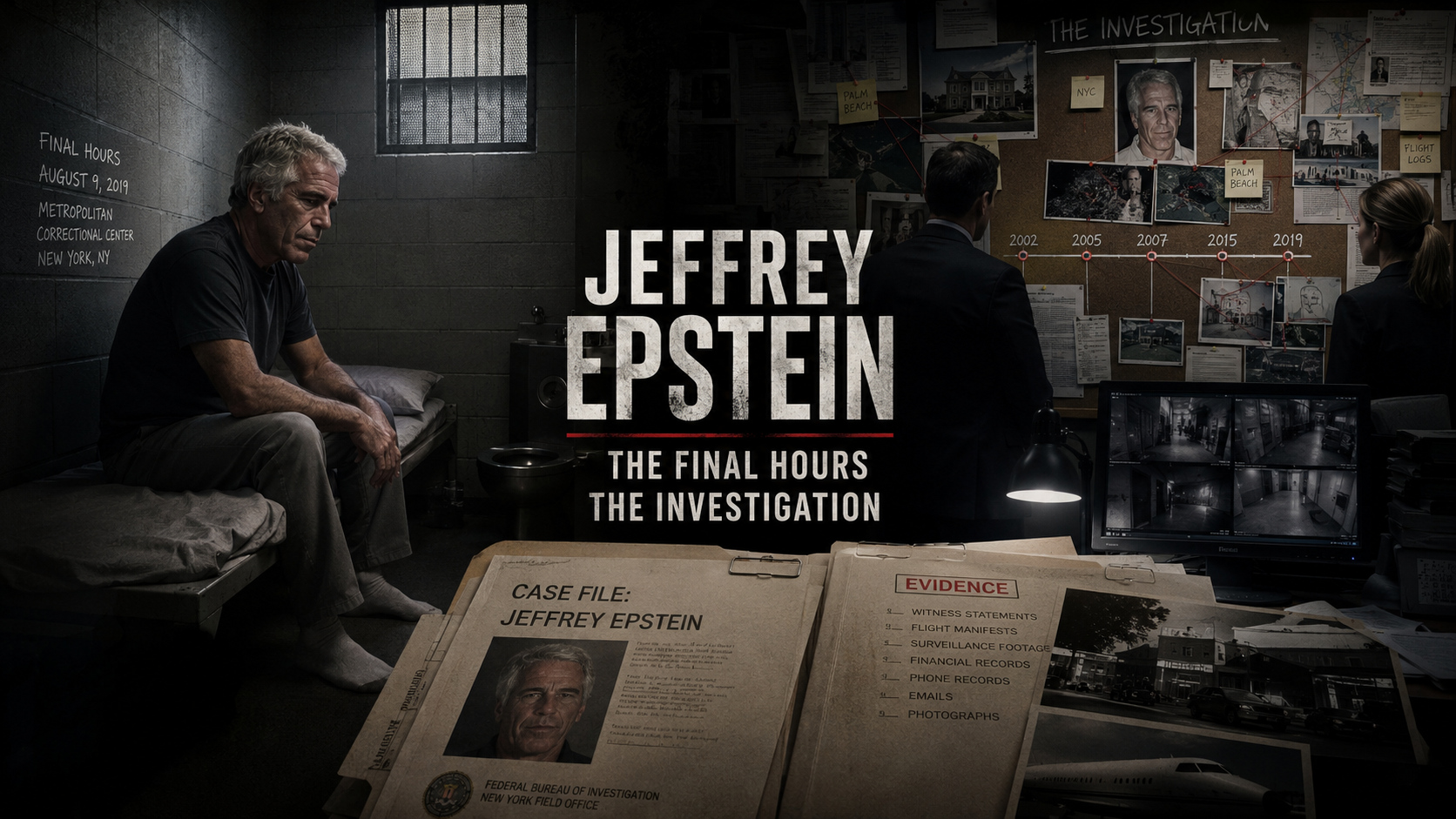
Epstein was not in a prison the way most people use that word. He was at the Metropolitan Correctional Center in Manhattan, MCC New York. An MCC is a federal administrative detention facility, a jail run by the Bureau of Prisons to hold people who are awaiting trial, not serving a sentence. MCC New York sat at 150 Park Row, right behind the federal courthouse, and for decades it held the highest-profile defendants in the Southern District of New York. It opened in 1975 and it had its own SHU. After Epstein died there, the scandal and the building's deteriorating condition led the Bureau to shutter it in 2021, and it has stayed closed since.
So this was not some understaffed county lockup. This was the federal pretrial jail attached to the most consequential prosecutor's office in the country (Southern District of New York), and Epstein was being held in its segregation unit, on the floor built for the highest level of control.
What Exactly Went Wrong?
I am not asking you to take my word for any of the failures that are laid out in the Department of Justice Office of the Inspector General report released in June 2023, and in the indictment of the two officers on duty. Here is what those official documents establish.
The two officers assigned to the unit did not conduct the required rounds. The Inspector General found that no thirty-minute rounds were performed after roughly 10:40 the night of August 9, and that the required inmate counts were not done either. The officers then falsified the count slips and round sheets to make it look like the checks had happened. They were later charged, and prosecutors said they had slept and used the internet instead of doing their job. That left Epstein unobserved and locked alone for close to eight hours. Curiously, I'm sure investigators checked the internet usage logs, but those details are still restricted in this case.
Oh, AND the cameras failed too. The Inspector General found that recorded video from the area was limited to a single working camera because the facility's recording system had malfunctioned starting around July 29. The unit built for the most watched man in the building was, on the relevant night, largely not being recorded. Pardon my expression, but WTF? A secured federal facility had a camera malfunction, let alone on the most notorious individuals in the most profiled holding facility in America?
During this time, Epstein was alone. Staff had been told days earlier to house Epstein with a cellmate for his safety after a July incident, and that order was not followed. He had no cellmate the night he died. Sheesh, another failure?
And there is an undocumented and unrecorded phone call? I cannot even phathom how that was possible since phone calls were strictly recorded, monitored, and LIMITED. The Inspector General found that a staff member allowed Epstein to make an exception to the rules and use a line that is unmonitored, unrecorded in violation of Bureau policy. Actually, shouldn't every line in a federal prison be recorded (just thinking practically aloud)? The staff member reported that Epstein requested to call his mother. We know he had not called his mother, since she was deceased. Epstein called someone with whom he reportedly had a personal relationship based on the interaction that the staff member recalled. Sit with all of these inconsistencies and violations just for a minute. I'm not asking of conspiratorial theory to even be considered...just basic reasoning. In a unit of the SHU where my movements at a minimum security camp were tracked down to the precise count and log, the most famous federal inmate in the world during that time was able to place an unmonitored phone call to his deceased mother.
Epstein's Will
Two days before he died, Epstein met with attorneys at the MCC and signed a brand new will. According to the probate documents filed in the U.S. Virgin Islands, he created a private vehicle called the "1953 Trust," named for his birth year, and used a pour-over will to funnel his entire estate, listed at more than $577 million dollars, into it. What changed from any earlier plan was the structure: a public will routes money where people can see it, but a private trust hides the beneficiaries and shields the assets from the women suing him, which is often considered a typical tactic to protect assets from litigation. The new will completely cut out his brother, who would have inherited Epstein's estate if Epstein had died with no will at all. Yet, the new will handed all assets to a secret trust, with two longtime associates named as executors.
Here is the part that genuinely unsettles me as someone who paid attention to how the BOP handles risk. The BOP's own suicide-prevention professional have noted that if a prisoner suddenly puts his affairs in order, signing a will, which may be read as a blatant warning sign. In the same window where staff were treating him as not imminently suicidal and easing his watch, he was doing the one thing BOP policy flags, which is a critical detail to note.
Was Epstein Suicidal?
This is where the official story becomes genuinely hard to square and of course details feign. According to BOP records, Epstein denied being suicidal again and again. At intake on July 8 he denied any suicidal thoughts. After the July 23 incident where he apparently attempted to hang himself, he was put on official "suicide watch," and after about thirty-one hours he was taken off it and stepped down to "psychological observation," with one staffer noting in the Inspector General's report , "it is not healthy to keep a person on watch too long." Epstein insisted he would not hurt himself. By his own account he was not the kind to do it, which family and friends have consistently protesting any notion of him being suicidal.
By the records, Epstein flatly rejected the idea, telling staff in substance that he was not suicidal and never would be.
On July 30, psychological observation was discontinued entirely. His attorneys did not describe a man telegraphing the end. He never alluded to suicide with the people around him. Then, he signed a new will. None of that proves anything by itself. The New York City medical examiner ruled the death a suicide by hanging, and the Inspector General said it found no evidence contradicting that ruling and no foul play. I am not insinuating other factors were at play. I am observing that an inmate who said he was not suicidal, who was taken off watch and left unwatched in a unit built so that being left unwatched cannot happen, is a set of facts that does not resolve cleanly. It's an odd set of facts when collectively analyzed.
The Final Record
- July 8, 2019
- During Epstein's psychological intake screening, he denied suicidal thoughts and was placed on "psychological observation" out of caution.
- July 23
- Epstein was found in his cell with a strip of cloth at his neck and placed on "suicide watch".
- July 24
- BOP removed Epstein from "suicide watch" after about 31 hours. Stepped down to "psychological observation".
- July 29
- MCC facility video recording system malfunctions, limiting later footage.
- July 30
- Psychological observation discontinued. Staff directed Epstein to be housed with a cellmate.
- Aug. 8
- Signs a new will, creating the private "1953 Trust" holding more than $577 million dollars.
- Aug. 9
- Epstein permitted to make an unmonitored phone call against policy to his deceased "mother". Left without a cellmate. No rounds after roughly 10:40 p.m.; logs later falsified.
- Aug. 10
- Found hanged around 6:30 a.m. Death ruled a suicide by the medical examiner.
Sourced from the DOJ Office of the Inspector General report (June 2023), Bureau of Prisons (BOP) records, the medical examiner's ruling, probate filings in the U.S. Virgin Islands, and CNN's reporting on Epstein's final nine months.
They Had One Job
The Inspector General did not mince words. He said a combination of negligence, misconduct, and outright job-performance failures left arguably one of the most notorious inmates in Bureau custody unmonitored and alone. And he made a point that I think gets lost in all the noise: those failures deprived Epstein's many victims of their chance at justice through the courts. The case died with Epstein's death.
Stripping any theory for a moment, the plain, undisputed truth is that the federal government had one job with this man: keep him safe and alive to face trial. During that time, he was the single most-watched prisoner in America. And the systems built precisely for that job, the rounds, the cameras, the cellmate order, the monitored phone, the suicide/psychological watch protocols, all failed in the same window, on the same night.
The SHU Works
This is going to sound strange after everything I just laid out, but I want to say it plainly for the families reading this who are scared about a loved one going into segregation. The SHU, operating the way it is designed to run, is one of the most protective environments in the entire prison system. Continuous observation and electronic monitoring systems. The issued prison smock that cannot be turned into a self-inflicting weapon. Cells stripped of anything dangerous. Guards required to lay eyes on you every half hour through the night, logged each time, and accounted by video surveillance. I witness all of this actively working at a minimum security camp on men in real crisis, and it kept them alive and safe.
As I mentioned in an earlier post while I was incarcerated, my former cellmate noted how did Epstein die in the SHU. That is exactly why Epstein's final moments land the way it does. The story is not that the SHU is a death trap, but complete the opposite. The SHU is built to make someone taking their own life near impossible. For Epstein's last moments, a series of human failures undid every layer of it at once, in the one place and on that one prisoner where you would expect every layer to hold. The protections are real and functional. They work when qualified and trained guards perform their duties. The tragedy and the strangeness both come from the fact that, this time, they were simply not followed or completed.
If you are about to enter the system, or you love someone who is, take the protective design of the SHU seriously and never assume a watch is for punishment. It is, at its best, the system trying to keep someone from harming themself. The lesson of that August night that sealed Epstein's fate is not to fear the prison's safeguards. It is to demand that the operations and the guards employed successfully run them with measure of full accountability. Any other conclusions certainly raise an eyebrow.
A note on a hard subject. This piece deals with suicide and a death while in federal custody. If you or someone you love is struggling, please reach out to a trusted person or a crisis line. If it would help, I can point you toward support resources.